Tuesday, 29 July 2014

New Zealand to strengthen ivory trade laws


New Zealand to strengthen ivory trade laws
“I’m thrilled that the New Zealand parliamentary committee has supported the petition. Every measure everywhere to stop the trade in ivory which is driving the massacre of elephants is important.”
-Helen Clark, United Nations / savingthewild.com
Press Release: SPCA
A petition mounted by an Auckland schoolteacher has won the support of a powerful Select Committee and has moved the New Zealand closer towards a fully enforceable ivory trading ban.
The New Zealand Select Committee Foreign Affairs, Defence and Trade announced on Friday that it supports the petition of Auckland schoolteacher Ms Virginia Woolf, which calls for a ban on all ivory trading within, to, and from New Zealand, and demands that all confiscated ivory held by the Crown be crushed.
“The Committee’s recommendation moves the New Zealand Government one step closer towards strengthening the laws and fixing the loopholes that currently enable some illicit ivory trading to occur in New Zealand,” says Bob Kerridge, Executive Director, SPCA Auckland.
http://www.savingthewild.com/2014/07/new-zealand-to-strengthen-ivory-trade-laws/

“When the buying stops, the killing can, too.”

WildAid’s mantra, translated into Chinese, has permeated China’s culture and society – a remarkable achievement in the mission to stamp out the US$10b illegal wildlife trade. In this two part interview with Peter Knights, WildAid’s Executive Director, I delve into what it will take to win the race for new Chinese thinking.
WildAid’s mission is to save endangered species that include elephants, rhino and tigers, by ending the illegal wildlife trade in our lifetime. It is the only organization with a laser focus on reducing the demand for these animal products, and they do this through public awareness campaigns featuring celebrity activists Yao Ming, Jackie Chan, Sir Richard Branson, Leonardo DiCaprio, and many more.
Working on a shoestring budget, WildAid are leveraging well over US$200 million in pro-bono media support, and reaching one billion people every week.
The most recent reports on WildAid’s shark fin campaigns in China show a demand reduction of up to 70% for shark fin soup, the result of appealing to people’s humanity. Did you know that millions of sharks are brutally killed each year for this soup? A third of all shark species are nearly extinct, but we can help save them.
Peter Knights, WildAid
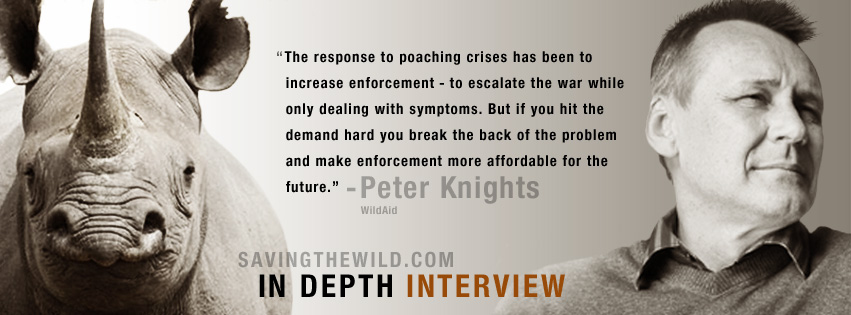
“The response to poaching crises has been to increase enforcement – to escalate the war while only dealing with symptoms,” says Peter Knights. “Demand reduction defunds the war and deals with the root cause. If you hit the demand hard you break the back of the problem and make enforcement more affordable for the future.”
Ivory carries more social status than shark fin soup, and ironically Buddhist ivory carvings are seen as religious devotion. However a lot of Chinese people still believe tusks are sourced from elephants that die a natural death, while others believe elephants shed their tusks like stags shed their antlers.
Fuelled by the country’s economic boom, China accounts for about 70% of the illegal ivory trade, and there is obviously still a long way to go. But progress is imminent, and Knights is encouraged by the Chinese government being open to their citizens debating environmental issues.
“The big win so far is China carrying out the ivory crush and admitting for the first time publicly that they had a problem. Hong Kong followed and their top three retailers have pulled out of the trade.”
China licenses 35 ivory carving factories and 130 ivory retailers to sell ‘legal’ ivory obtained from the 2008 CITES sanctioned sale of ivory stockpiles from four African countries. However some legal operations have been caught out as fronts for smuggling, and other carving factories are not licensed at all. Calls to shut down the factories and distribution channels are routinely ignored in contradiction to the ongoing confiscated ivory stockpile burns. But the future is unwritten.

Read more  from savingthewild.com

Friday, 25 July 2014

Can Drones Help Tackle Africa’s Wildlife Poaching Crisis?

Can Drones Help Tackle Africa’s Wildlife Poaching Crisis?

BBCNews/Getty Images
Anti-poacher drones will complement rather than replace sniffer dogs and teams of armed, GPS-tagged rangers connected by a digital radio system, BBCNews reports.
Interest in anti-poacher drones is global and rapid advances in drone technology will play a significant role in anti-poaching and wildlife conservation, according to the report – but only as part of an integrated, ground-to-air tracking and surveillance system.
A low-cost drone competition – the Wildlife Conservation UAV Challenge — has received nearly 140 entries.
BBCNews/Getty Images
The winners will be announced in November, and their drones will be tested in South Africa’s Kruger National Park.
“Kruger National Park is ground zero for poachers,” said Crawford Allan, spokesman for the World Wildlife Fund’s crime technology project. “There are 12 gangs in there at any time. It’s almost like a war zone.”
A Kenyan 90,000-acre reserve, Ol Pejeta Conservancy specializes in protecting white and black rhinos. Ol Pejeta has teamed up with San Francisco-based tech Airware, which makes drone autopilot systems.
“With the blessing of the Kenya Wildlife Service we did 10 days of testing,” said Robert Breare, Ol Pejeta’s chief commercial officer, in a BBC interview.
Park rangers can operate the drone via two laptops, one showing the drone’s point of view through a high-definition camera and the other showing a map tracking the flight path.
Thermal imaging cameras mean the drone can also fly at night, with the operators able to differentiate the shapes of animals.
Based on testing, they can even see how the elephants’ trunks changed temperature as they sucked up water from a trough.
With a wingspan of less than a meter, the catapult-launched test drone flew at an altitude of about 500 feet.
“You hardly see or notice it,” Breare said. “We don’t want to startle the wildlife… or the tourists.”
Killing rhinos for their horn and elephants for their tusks is a multi-million dollar business with Asia driving demand. The trade is threatening Africa’s wildlife tourism industry.

Wednesday, 16 July 2014

Dont miss the hilarious Hells gate trip in Naivasha for only 2700/= for 2days 1 night

 BOOK NOW!!!!!!!

We welcome all to our exclusive Trip tour and camping at Hells Gate. Our package is inclusive
camping, touring biking and hiking and the best mbuzi choma inclusive.


All this under one cheap package of CITIZENS 2700/= PER HEAD, RESIDENTS 3500/=, NON RESIDENT 4200/=. It will be on 19th September 2014. expected capacity is 40 people. All are welcome for the best excursion experience at the Hells gate Park. The trips runs for 2 days 1 night.

ALL ARE WELCOMED. CITIZENS 2700/= PER HEAD, RESIDENTS 3500/=, NON RESIDENT 4200/=.
ENJOY THE BEST MOMENTS WITH
TIGER REVOLUTION SAFARIS

MAJOR ATTRACTIONS

Game viewing

Raptor nesting in cliffs

Spectacular Gorge walk

Hot springs

The Olkaria Geothermal Station

The Mervyn Carnelley Raptor Hide

Fischer’s Tower

Tourist circuits, nature trails and picnic sites

WILDLIFE

Buffalo, zebra, eland, hartebeest, Thomson’s gazelle and giraffe, baboons, serval cat and klipspringer antelopes


Prolific bird life features 103 species.


 for more contact John 0724337652
email johnkangethe@kenyandocumentary.com
or johnnykangethe@gmail.com
www.kenyandocumentary.com