Tuesday, 19 August 2014

How to prepare for a photo safari

 Photographic safaris are outings that should be experienced by every photographer at least once in a lifetime. They provide the perfect opportunity to photograph wildlife and nature. Most offer private vehicles allowing photographers to focus on specific wildlife, spend the needed time with the wildlife to get the shot, and allow for a more flexible approach to the safari.
Most importantly, these safaris are hosted by an expert wildlife photographer to assist clients with getting the perfect shot and then processing the images.

Preparing for your first photo safari:
• Contact the operator of your chosen photographic safari company and confirm with them what their recommended equipment is. This can vary from area to area, especially with regards to lenses. Some reserves allow vehicles to follow animals off road and one can get away with shorter lenses e.g. 200mm, while others do not allow this and thus longer lenses are required e.g. 600mm.
• Spend time getting to know your camera and equipment. Wildlife photography is definitely not static and you should be able to change settings quickly according to fast moving subjects or shifting light.
• Practice by photographing pets or birds in your surrounding area in order to get a feel for photographing a moving subject.
• If you are a true amateur, don’t worry! This is exactly why an expert wildlife photographer joins you on safari. The host will assist you with the best camera settings and how to get the best out of your camera.

What you should take:
• A camera and lens within your price range (some operators offer equipment rental). Lens wise, it is good to have a wide angle lens for landscapes and a telephoto lens for the animals.
• An external flash with spare batteries. It is recommended to bring a wireless flash transmitter to avoid “red-eye”.
• A shutter release switch for star trails.
• Take enough memory cards (high speed). I have shot 8GB in RAW images in less than an hour on a safari before, so it is important to have enough backup memory. It is recommended to bring an external storage device to transfer images onto after each safari. The reason why I say ‘high speed card’ is due to the fact that often in wildlife photography one shoots on high speed continuous mode.
• Take spare batteries, as game drives can last for hours at a time.
• A good laptop powerful enough to process images on Photoshop/Lightroom. Some operators offer monitors to uplink to for editing purposes but if not, bring a laptop with dedicated graphics and an RGB LED screen.
• A memory card reader.
• A good lens cleaning kit is essential, as being out in the elements does lead to dust collection.
• Insure your equipment! Weather can be unpredictable and I have had a client lose a Canon 600mm lens in a freak wind storm that caused a log to fall on the lens. The lens was not insured.
• Bean bag or vehicle mount to hold your camera nice and still while shooting.
• Plastic packets or waterproof material! Thunderstorms are common in Africa through the summer months, so bring something just to cover up that lens or camera.
• Bring a lot of patience! Wildlife photography is often about waiting for the right moment, but under the guidance of you host and guide, this wait will be more than worth it.
• A willingness to learn and share. It is important on these safaris to be willing to learn, not just about photography but about the creatures you are photographing. The more you learn about animal behaviour, the better, as it will allow you to anticipate your next shot. Share with the others on safari as everyone has some idea or technique that may just help others.
• An ethical respect for nature is very important. Not only is it unethical to disturb animals to get a shot, but it can at times put you and the rest of the clients in danger.


Tuesday, 29 July 2014

Southern Black Rhino: A Retrospective


During the 1980s and 1990s the country of Zimbabwe had a thriving population of black rhinos and they were managed well by the government and by private ranchers. Unfortunately, poaching came to their country and the conservation of many species was threatened—including black rhinos.
RS16328__DO37067
RS2335_6.05
RS11711__DO37002
Captive rhino managers in the United States and Australia combined resources and approached the government of Zimbabwe with the idea of bringing ten rhinos to the United States and ten rhinos to Australia as an assurance population against the extinction of the species in Zimbabwe. Fossil Rim was an instrumental player in the formation of the International Black Rhino Foundation (now called the International Rhino Foundation—and focusing on all rhino species), which had the mission of capturing, transporting and managing southern black rhinos ex situ (outside of their normal range,

New Zealand to strengthen ivory trade laws


New Zealand to strengthen ivory trade laws
“I’m thrilled that the New Zealand parliamentary committee has supported the petition. Every measure everywhere to stop the trade in ivory which is driving the massacre of elephants is important.”
-Helen Clark, United Nations / savingthewild.com
Press Release: SPCA
A petition mounted by an Auckland schoolteacher has won the support of a powerful Select Committee and has moved the New Zealand closer towards a fully enforceable ivory trading ban.
The New Zealand Select Committee Foreign Affairs, Defence and Trade announced on Friday that it supports the petition of Auckland schoolteacher Ms Virginia Woolf, which calls for a ban on all ivory trading within, to, and from New Zealand, and demands that all confiscated ivory held by the Crown be crushed.
“The Committee’s recommendation moves the New Zealand Government one step closer towards strengthening the laws and fixing the loopholes that currently enable some illicit ivory trading to occur in New Zealand,” says Bob Kerridge, Executive Director, SPCA Auckland.
http://www.savingthewild.com/2014/07/new-zealand-to-strengthen-ivory-trade-laws/

“When the buying stops, the killing can, too.”

WildAid’s mantra, translated into Chinese, has permeated China’s culture and society – a remarkable achievement in the mission to stamp out the US$10b illegal wildlife trade. In this two part interview with Peter Knights, WildAid’s Executive Director, I delve into what it will take to win the race for new Chinese thinking.
WildAid’s mission is to save endangered species that include elephants, rhino and tigers, by ending the illegal wildlife trade in our lifetime. It is the only organization with a laser focus on reducing the demand for these animal products, and they do this through public awareness campaigns featuring celebrity activists Yao Ming, Jackie Chan, Sir Richard Branson, Leonardo DiCaprio, and many more.
Working on a shoestring budget, WildAid are leveraging well over US$200 million in pro-bono media support, and reaching one billion people every week.
The most recent reports on WildAid’s shark fin campaigns in China show a demand reduction of up to 70% for shark fin soup, the result of appealing to people’s humanity. Did you know that millions of sharks are brutally killed each year for this soup? A third of all shark species are nearly extinct, but we can help save them.
Peter Knights, WildAid
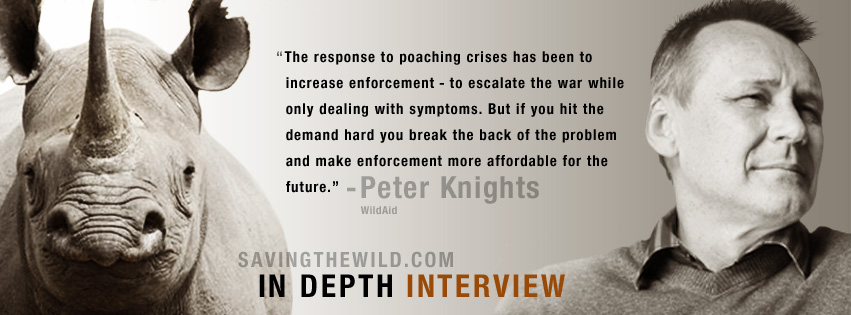
“The response to poaching crises has been to increase enforcement – to escalate the war while only dealing with symptoms,” says Peter Knights. “Demand reduction defunds the war and deals with the root cause. If you hit the demand hard you break the back of the problem and make enforcement more affordable for the future.”
Ivory carries more social status than shark fin soup, and ironically Buddhist ivory carvings are seen as religious devotion. However a lot of Chinese people still believe tusks are sourced from elephants that die a natural death, while others believe elephants shed their tusks like stags shed their antlers.
Fuelled by the country’s economic boom, China accounts for about 70% of the illegal ivory trade, and there is obviously still a long way to go. But progress is imminent, and Knights is encouraged by the Chinese government being open to their citizens debating environmental issues.
“The big win so far is China carrying out the ivory crush and admitting for the first time publicly that they had a problem. Hong Kong followed and their top three retailers have pulled out of the trade.”
China licenses 35 ivory carving factories and 130 ivory retailers to sell ‘legal’ ivory obtained from the 2008 CITES sanctioned sale of ivory stockpiles from four African countries. However some legal operations have been caught out as fronts for smuggling, and other carving factories are not licensed at all. Calls to shut down the factories and distribution channels are routinely ignored in contradiction to the ongoing confiscated ivory stockpile burns. But the future is unwritten.

Read more  from savingthewild.com